

Great News Daily. All the news that’s fit to uplift.

No. 16AI & Tech edition ↗
Good news. Eyes open.

Real progress, curious people and useful ideas. A short read with sources, a sense of humor, and no obligation to pretend everything is fine.

A whimsical Earth swings two paper spacecraft toward a distant Mars. Conceptual art, not an orbital diagram.
Original editorial illustration

EARTH GIVES A PUSH

Two Mars probes complete their Earth flybys

NASA's ESCAPADE spacecraft have begun their cruise toward Mars after two successful powered assists.

Read the story

NASA reported on November 9 that both ESCAPADE spacecraft had completed powered Earth flybys, combining our planet's gravity with engine burns to send them toward Mars. The first maneuver took place on November 7; the second followed on November 9.

The mission is trying a different departure strategy. After launching in November 2025, the probes spent time in a loiter orbit before returning to Earth for this push. NASA says this was its first use of a powered Earth flyby to propel spacecraft toward Mars.

The achievement is the completed departure maneuver. Mars orbit-insertion burns are planned for September 7 and 9, 2027, with science operations expected to begin in June 2028. The probes will study the solar wind's interaction with Mars and its role in atmospheric loss. There is a long journey left, but both spacecraft have cleared an important step.

NASA ↗

Source published November 9, 2026; flybys completed November 7 and 9.
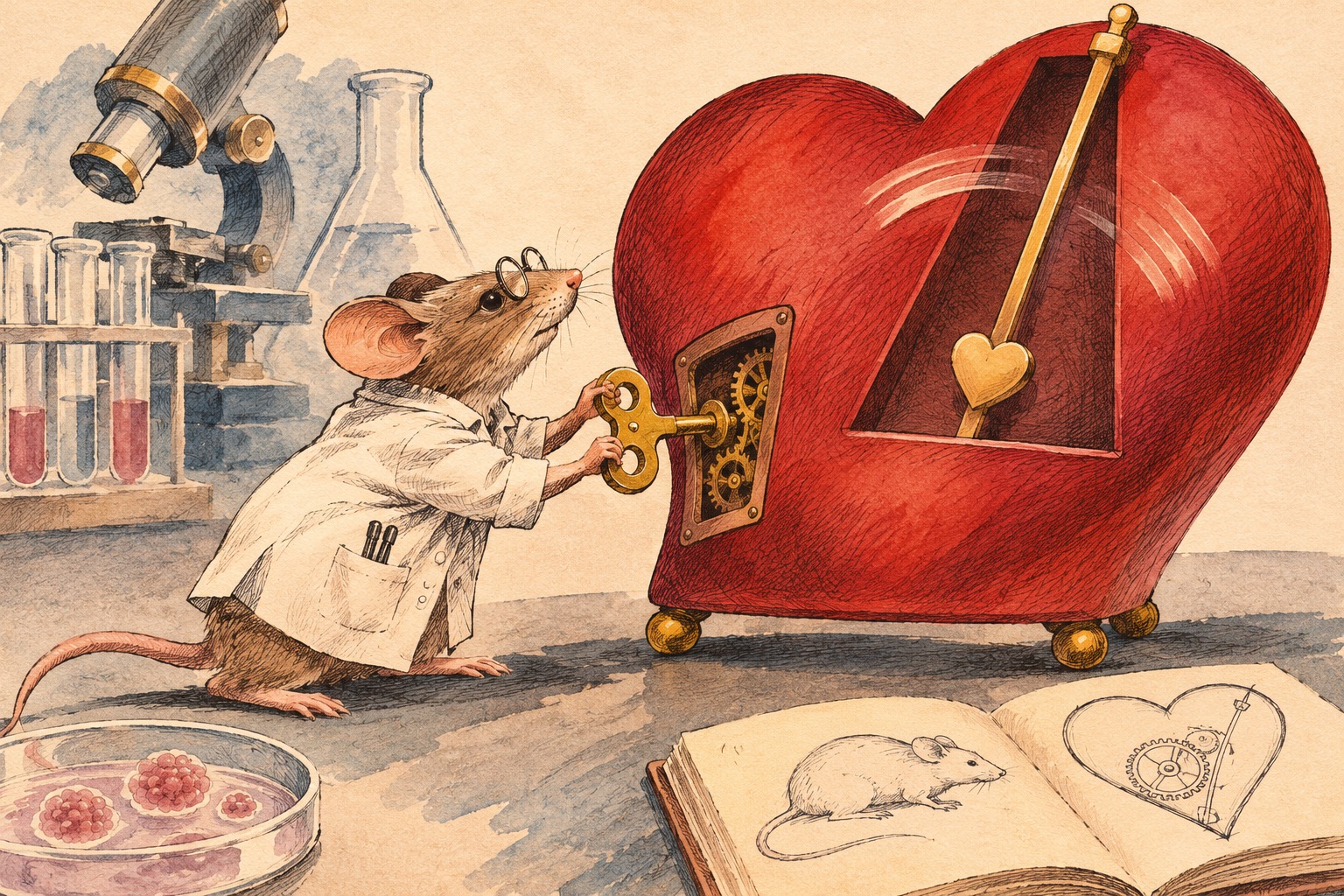
A mouse researcher winds a heart-shaped metronome, an imaginative metaphor for early research in mice.
Original editorial illustration

A SMALL HEART RESTART

An experimental treatment helps damaged mouse hearts

Early mRNA research encourages heart-muscle repair, with larger-animal and human testing still ahead.

Read the story

Cambridge researchers report that a temporary mRNA treatment encouraged damaged heart-muscle cells to divide in mice after a heart attack. The treatment activates two proteins, Myc and Cyclin T1, and was injected into the animals' hearts.

The university's November 9 account says treated mice pumped around 10% more blood with each beat than mice given a mock treatment. Reassessment after 28 days and 12 weeks found that the improvement persisted. The researchers reported no observed adverse effects in the study.

Those results do not establish safety or effectiveness in people. The team says larger-animal studies and then human trials are needed. The encouraging advance is narrower and concrete: a temporary, localized intervention promoted repair and improved measured heart function in an animal experiment. It gives researchers a result to build on, rather than a treatment patients can use today.

University of Cambridge · study in Nature Cardiovascular Research ↗

Source published November 9, 2026; animal-study results.

Two ribbon acrobats reveal a hidden handshake while stretching; a metaphor, not a molecular diagram.
Original editorial illustration

THE CELLULAR HANDSHAKE

Researchers find a new way cells respond to force

Stretching a protein exposes an unexpected connection, helping resolve a decades-old biological puzzle.

Read the story

A University of Liverpool-led team reports a new mechanism in talin, a protein that helps cells attach to their surroundings and sense mechanical forces. When talin stretches, it can expose a region that allows talin molecules to bind to each other.

The work clarifies the role of a region long thought to be chiefly an attachment site for integrins. The researchers found that another protein, vinculin, can separate the talin assemblies again, adding a way to control the connection.

The study appears in Proceedings of the National Academy of Sciences. Liverpool's November 9 account describes molecular properties resembling those associated with amyloid formation, used here for a useful cellular function. That resemblance does not make this an Alzheimer's treatment. The good news is a clearer account of a basic biological mechanism: cells have another way to turn a physical pull into a controlled response.

University of Liverpool · study in PNAS ↗

Source published November 9, 2026.

Take something good with you

Small steps count. So do the people taking them.

Know a story that deserves a little daylight? Keep looking close to home.

Create your own newspaper ↗