● TabBOOOne page. More perspective.✎ Customize
Your world, one good read at a time

TabLOID

The cells want a group chat. The robots want subcontractors.

No. 9 · Miami BeachThursday, October 8, 2026Read at your own pace
Instinct AI illustration of scientists and a retro robot studying a glowing cell
Catch up quick
  1. Biohub's $1.8B biology effort combines funding, existing data, computing and new measurements. The goal: better virtual cells.
  2. Grok Bot is reportedly recruiting rival models. The robot switchboard is getting crowded.
  3. Google's Playground turns game ideas into browser games. Unity Spark is still coming.
  4. Haiku 5.5 has lower prices, but the prompt-size threshold matters.
  5. A big brother is a bone marrow match for his sister. And a rescued seal has found her permanent home.

Open what interests you

01SCIENCE DESKThe cell gets a $1.8B group projectData first. Virtual biology second.Instinct AI illustration of a glowing cell in a retro laboratory

Biohub's October 7 announcement brings together $1.8 billion in funding, data, computing and new measurement technology to support predictive biology. The aim is to help researchers model what happens when a cell encounters a drug or a gene change.

Here's the accounting: DOE plans more than $500 million over five years. NIH is contributing datasets built through more than $500 million of prior federal investment. Google DeepMind, Isomorphic Labs and Meta collectively bring $300 million, alongside Biohub's founding commitment. These contributions make up the headline effort; they aren't all new cash, and the $300 million shouldn't be counted twice.

The partners want open, standardized measurements that researchers can use together. This announcement lays foundations for more capable virtual-cell models. It doesn't announce a finished universal model or an available treatment.

Language models had mountains of internet text. Biology needs measurements you can actually compare. The cells have finally been invited to the group chat.


Read Biohub's announcement

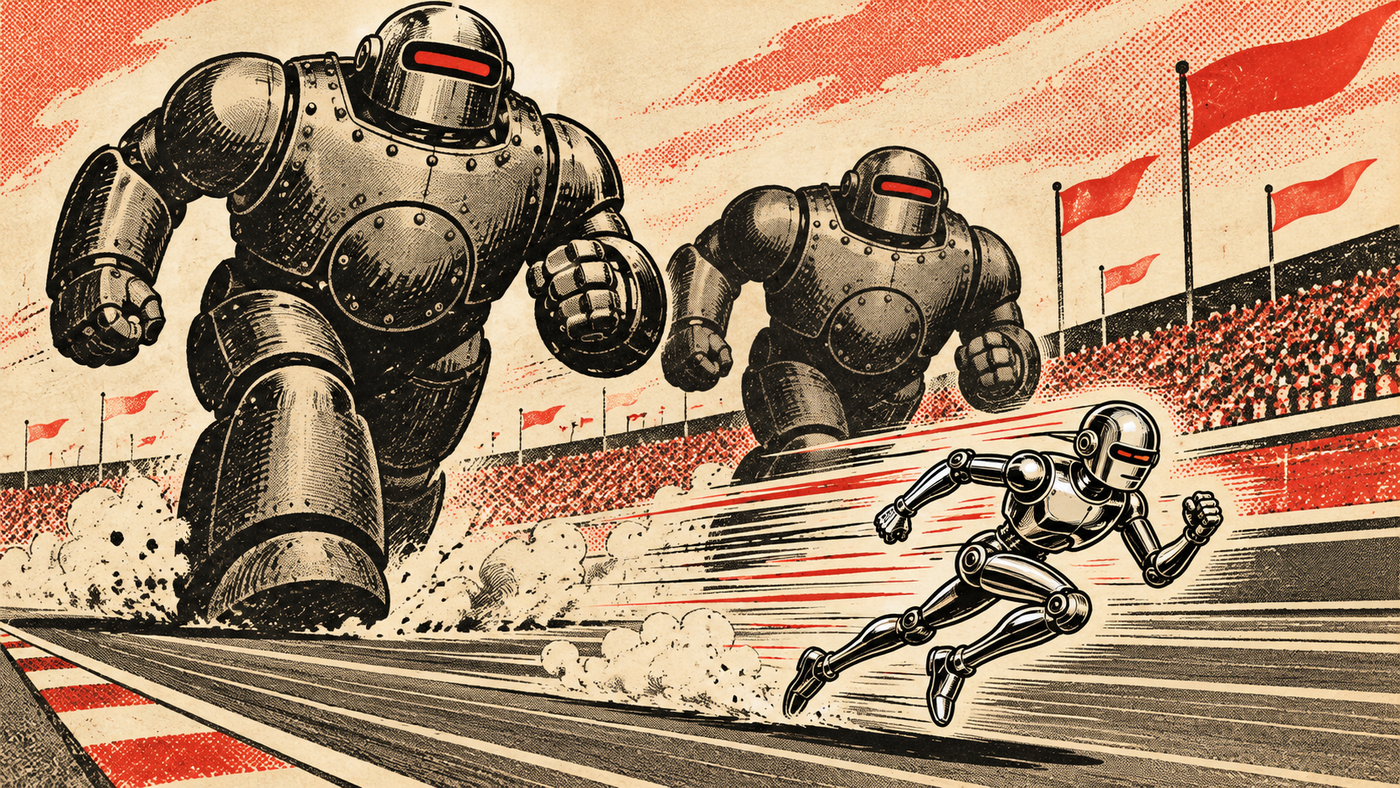
02AGENT DESKGrok hires the competitionThe switchboard might be the product.Instinct AI illustration of a robot routing trains through a switchyard

The Next Web reports that Elon Musk announced plans for Grok Bot to route tasks to whichever backend model fits best, including Claude Opus 5.5, Midjourney and Suno. The October 7 report cites his X post.

This is an announcement, not our hands-on test. Routing rules, access and pricing weren't established in the report. The interesting idea is the division of labor: one interface, several specialist engines. Even robots apparently need to know when to call a freelancer.

The Next Web's report · The cited announcement

03GAME DESKPitch a game. Play a game.Google gives the blank canvas a chat box.Conceptual Instinct illustration of a robot magician creating interactive worlds

Google launched Playground on October 7, an experimental platform for making games through text prompts. Describe characters, rules or physics, test the result, then ask for changes. Games run in a browser on a phone or laptop.

You can keep a game private, share a link or publish it to the community gallery. Select genres support multiplayer and leaderboards. Launch access is for U.S. adults, with creation access rolling out in tiers tied to Google AI subscriptions.

Unity Spark integration is planned; Google says it is in testing with a closed beta coming. Don't confuse the demo reel with an integration you can already use. Still, a rough prototype beats another document called Game Idea FINAL v7.

Google's launch post

04POLICY DESKClaude has a heckler rule nowYou can disagree. You can even be annoyed.Conceptual robot illustration for agent operating rules

Anthropic's October 8 usage-policy update takes effect November 12. One new rule covers sustained, needless cruelty toward its models in extreme cases with no discernible purpose.

The company explicitly excludes ordinary frustration, pushback, dark creative themes, testing and research. Claude's ability to end rare persistently abusive conversations remains its main enforcement mechanism. A bad answer can still get a bad review. The robot hasn't become your manager.

For people building agents that move physical equipment, there's a more practical change: a qualified operator must be able to observe and stop potentially injurious machinery, and the equipment must hold a safe state if Claude disconnects. A robot arm needs an actual stop button.

Read Anthropic's update

05VERIFICATION DESKAI watermarks get a public detectorUseful evidence. Not a universal lie detector.Conceptual Instinct switchyard illustration for tracing digital media

Google opened SynthID Detector globally in English on October 7. Upload an image, video or audio file to look for the imperceptible watermarks used by Google and participating partners, including OpenAI, NVIDIA and Kakao.

What matters is the scope. This checks for supported watermarks; it doesn't establish that every unmarked file is human-made. Treat a result as one clue about provenance, alongside the source and context. The internet still needs your brain switched on. Annoying, we know.

Google's announcement

06MODEL DESKHaiku's smaller bill has fine printThe 100K-token line matters.Conceptual Instinct illustration of a small speedy robot

Anthropic's Haiku 5.5 pricing lists $0.10 per million input tokens and $0.50 per million output tokens for prompts up to 100,000 tokens. Above that threshold, the listed rates are $0.50 input and $2.50 output. Cache reads and writes have separate prices.

Anthropic says the model costs around 75% less to run on average than Haiku 4.5. That's a vendor-reported average, not a promise about your workload. Its adjustable effort setting also changes the cost-versus-capability tradeoff.

The sensible use case is short, repetitive jobs: classification, compaction and summaries. Cheap per token is useful. Sending a tiny task an entire filing cabinet is still a choice.

Check the pricing table

07XR DESK$1,279 glasses. Computer sold in the same story.Aura keeps the heavy thinking in a puck.Conceptual robot illustration for new computing hardware

XREAL's October 7 announcement puts AURA's U.S. starting price at $1,279 for the 12GB/256GB configuration; 16GB/512GB is $1,499. The Android XR system pairs see-through glasses with a tethered compute puck. It isn't simply glasses wired to your existing phone or laptop.

Initial preorder access is for customers who placed qualifying reservations before October 7. XREAL says wider orders will follow and shipping begins soon in the U.S., Canada, Japan and South Korea. Exact regional timing is still to be announced.

Wearable screen, pocket computer, visible cable. The future has arrived with accessories.

XREAL's release, carried by Nasdaq

08HARDWARE DESKSurface's charging cable knows when to leaveThe cable detaches. Your port stays put.Conceptual robot illustration for portable computing

Microsoft opened Surface Laptop Ultra preorders on October 7 at a starting MSRP of $2,599, with availability beginning October 16. The laptop is built around NVIDIA RTX Spark and offers configurations with up to 128GB of unified memory.

The small, useful detail: Magnetic Connect lets the included charging cable attach magnetically to the right-side USB-C port and release easily. The port itself remains available for video, data and other USB-C devices. It doesn't pop off the computer.

Performance figures in the announcement are Microsoft's claims, not our test results. The cable feature, however, is a very clear pitch to anyone whose foot has tried to launch a laptop.

Microsoft's device announcement

09MONEY DESK$92B went to startups. AI ate most of the buffet.Quarterly totals aren't a verdict on your idea.Conceptual Instinct switchyard illustration for startup funding flows

Crunchbase counted $92 billion in seed-through-growth funding for U.S. and Canadian startups in Q3 2026. That's down 35% from the previous quarter but up 50% from a year earlier. Roughly two-thirds went to AI-focused companies.

Its report says the quarterly dip largely reflects the absence of fresh mega-rounds for OpenAI and Anthropic; early- and late-stage deal counts stayed close to the previous quarter. These are Crunchbase's dataset and categories, not a census of every business.

For founders, the practical takeaway is concentration: a handful of giant checks can move the headline. Build something people want, not a pitch deck that can pronounce agentic in three accents.

Read Crunchbase's data report

Today's good news

Big brother. Bigger gift.

Amari Rose, 13, is a bone marrow match for his nine-year-old sister, Alexa Turner, who has sickle cell disease. WBRC reports that the Alabaster, Alabama, siblings are preparing for a transplant scheduled for January. Their mother says their positive attitudes help her face what's ahead. The treatment is still to come, but the match gives this family a concrete reason for hope.

Read the source ↗
More good news

Pearl found her people. And her pool.

Today's extra good news comes from NOAA's October 8 report: rescued gray seal Pearl has a permanent home at Connecticut's Maritime Aquarium at Norwalk. A spinal deformity meant another return to the wild was unlikely to be safe. Rescue teams, veterinarians and aquarium staff found a place that can meet her needs, and she's settling in with the resident seals. Her caregivers say she's already ahead of her training goals. An excellent day for a very round new roommate.

Read the source ↗
Close ×Enlarged comic