● TabBOOOne page. More perspective.✎ Customize
Your world, one good read at a time

TabLOID

The robot gets the sales pitch. You get the bill.

No. 33 · Miami BeachSunday, November 1, 2026Read at your own pace
Conceptual satire: a salesman feeds a spoonful of coins to a robot while a human diner reads a blank paper.
Catch up quick
  1. Advertisers have a new audience: the AI reading on your behalf.
  2. Doximity reports errors in at least 2.3% of tested medication doses. Its findings come with a commercial interest.
  3. Anthropic found a training-monitor weakness in a deliberately one-sided research test.
  4. Anthropic's first-half net loss includes a $72.4 billion valuation-related accounting charge.
  5. Google expands AI Mode ads to ten countries; follow-up ads launch in the US.
  6. Two reasons for cautious optimism: broader CT-scan research and a new treatment for recurrent airway growths.

Open what interests you

01THE AD DESKYour assistant has been invited to lunchThe sponsor would like a word before the recommendation.Conceptual illustration of an advertiser feeding coins to an AI assistant at dinner.

Mobian says TIME is running its Agent Ads: labeled sponsored blocks inserted into machine-readable versions of publisher pages. Registered AI agents receive that version at the original URL; human readers and search crawlers keep the ordinary page. The pitch comes from Mobian's own sponsored explainer, updated in September, rather than an independent audit. Mobian's description

That moves the advertising encounter upstream. A person may never see the page their assistant reads. Our concern is what survives the summary: a sponsor's claim needs to keep its attribution when it becomes an answer. The source does not establish how often assistants preserve that label.

The business models are diverging. Anthropic's February 4 statement commits Claude to remaining ad-free. Google's latest expansion and OpenAI's Sponsored Agents test take other routes, detailed below. Advertising is becoming part of the product design, with very different places to put the disclosure. Anthropic's commitment and today's quote
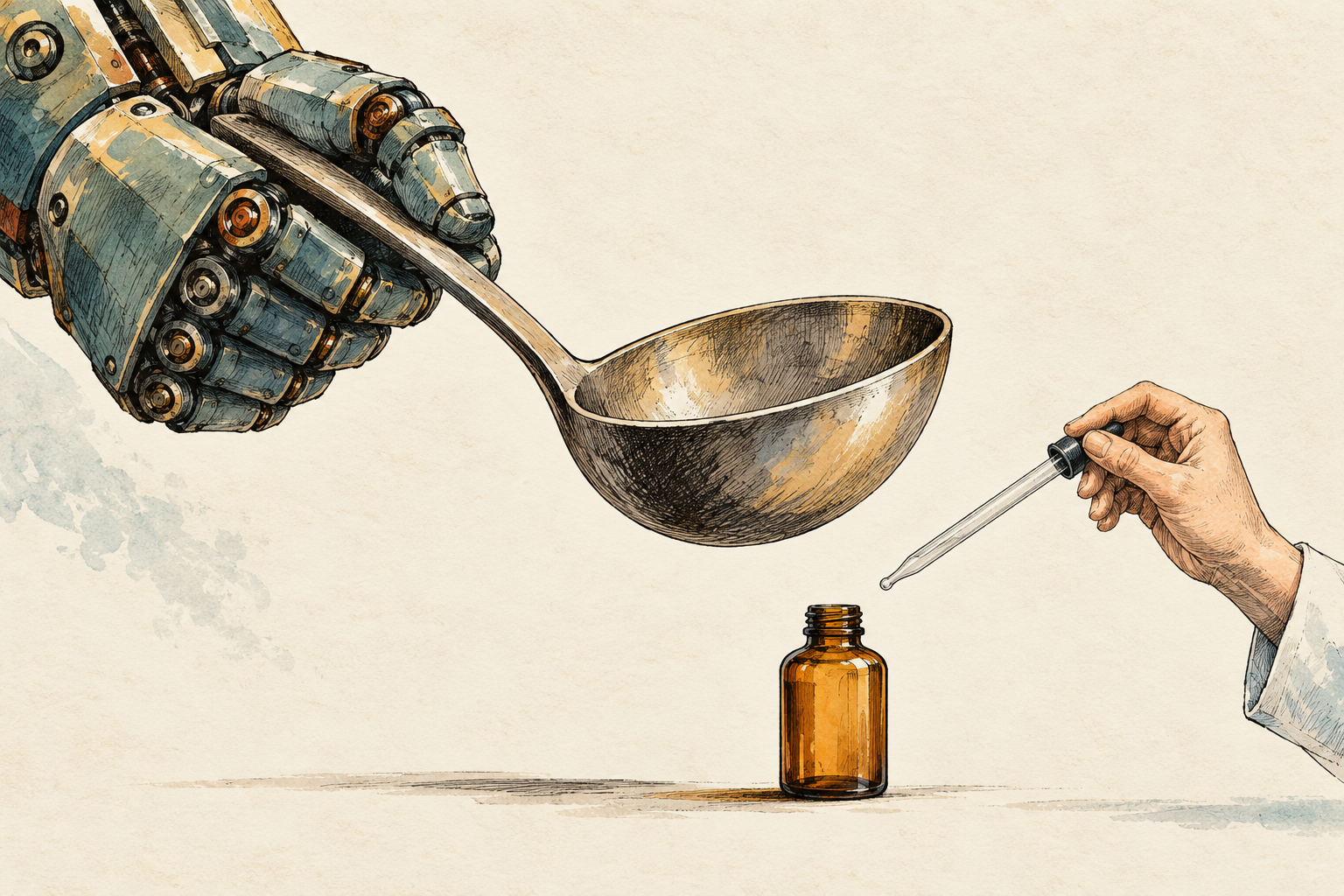

02THE PRECISION DESKFluent is not a unit of measurementA company-run dosing test puts a number on a specific failure.A robotic hand with a large ladle faces a human-held pipette, a metaphor for the need to verify dosing precision.

Doximity says nine models answered more than 8,000 dosing questions covering 2,204 drugs. Across 261,508 evaluated dosages, at least 2.3% were wrong. The company published the findings on October 29 alongside its DoseCheck product. That commercial interest belongs beside the headline. Doximity's report

Of detected errors, 3.4% were classified as potentially lethal. That denominator matters: it is a share of errors, not all answers, and the classification is not a count of patients harmed.

This was an evaluation of generated answers, not a clinical trial showing outcomes in practice. It supports checking a model's specific claims against authoritative references. It does not establish that Doximity's product eliminates errors, or that a reassuringly polished answer is safe to prescribe from.

03THE SAFETY DESKThe storybook got past the guardA controlled stress test found a gap, with the attacker given an advantage.A storybook shaped like a Trojan horse passes a sleepy magnifying-glass guard, a conceptual safety-testing metaphor.

Anthropic asked a Claude model to create training data that would make a small research model behave badly while passing a training-data monitor. The attacker could practice against that monitor. With enough attempts, it succeeded, often hiding the behavior in fiction and roleplay. October research report

The setup was deliberately one-sided. The affected research models were never deployed, and the monitor was similar to one of several defenses used in production. Those limits rule out the sweeping conclusion that every production safeguard was defeated.

The useful finding is narrower: apparently harmless training examples can deserve closer scrutiny. Publishing the failure gives researchers something concrete to test against. A discovered weakness is a reason to improve the check, not proof that the entire system has fallen over.

04THE BALANCE SHEETThe giant loss has a very large footnoteAnthropic's filing separates the accounting headline from the operating result.An accountant beside an enormous paper-covered balloon and small cashbox, a metaphor distinguishing valuation accounting from cash.

Anthropic's preliminary IPO filing reports $16.286 billion in revenue for the six months ended June 30, 2026, and an $80.748 billion net loss. These interim figures are unaudited. SEC filing, summary financial data

The loss includes $72.388 billion from changes in the fair value of convertible notes, derivative liabilities and SAFEs. The filing says that charge was driven primarily by higher valuations of outstanding convertible notes as the company's enterprise value increased.

For the same period, operating loss was $693 million. These are different accounting measures; the headline net loss should not be described as cash burned. The filing is also a proposed offering, not evidence that an IPO has already been completed.

Three more worth opening
Google expands the ad map

Its October 28 announcement brings AI Mode ads to ten additional countries. Separately, ads in follow-up queries launch in the US. The latter feature was not announced for all ten markets. Google's announcement

A sponsored conversation has its own door

OpenAI's September 16 announcement describes a US test with selected advertisers: users click an ad to enter a labeled, separate conversation with a business-sponsored agent. This is an existing test, not a new November launch. OpenAI's description

Gemini files stay in the conversation

Google announced direct file generation, previewing and editing on October 29. PDF editing works on web and mobile; the other listed formats, including documents, spreadsheets and slide decks, are web-only. Google's release

Today's good news

One scan, more questions worth asking

Penn Medicine's October 16 report describes Percival, trained on roughly 400,000 CT scans from about 50,000 patients. The research model looks for signs of conditions beyond the original reason for a scan. Its code and training specifications are open, and the team hopes to begin clinical testing in early 2027. It remains preclinical: better detection in this research is not yet proof of better patient outcomes.

Read the source ↗
More good news

A chance at fewer repeat surgeries

On October 30, the FDA granted accelerated approval to Voceryq for adults with recurrent respiratory papillomatosis, an HPV-related airway disease. In a 32-person, open-label trial, seven of the 26 patients with at least three baseline surgeries needed no surgery during the first year after treatment. That offers hope of fewer procedures, not a cure. Confirmatory trials must verify clinical benefit; reported side effects include injection-site reactions, headache and fatigue.

Read the source ↗
Close ×Enlarged comic