● TabBOOOne page. More perspective.✎ Customize
Your world, one good read at a time

TabLOID

Long commitments. Everyday tests. A world waiting in line.

No. 35 · Miami BeachTuesday, November 3, 2026Read at your own pace
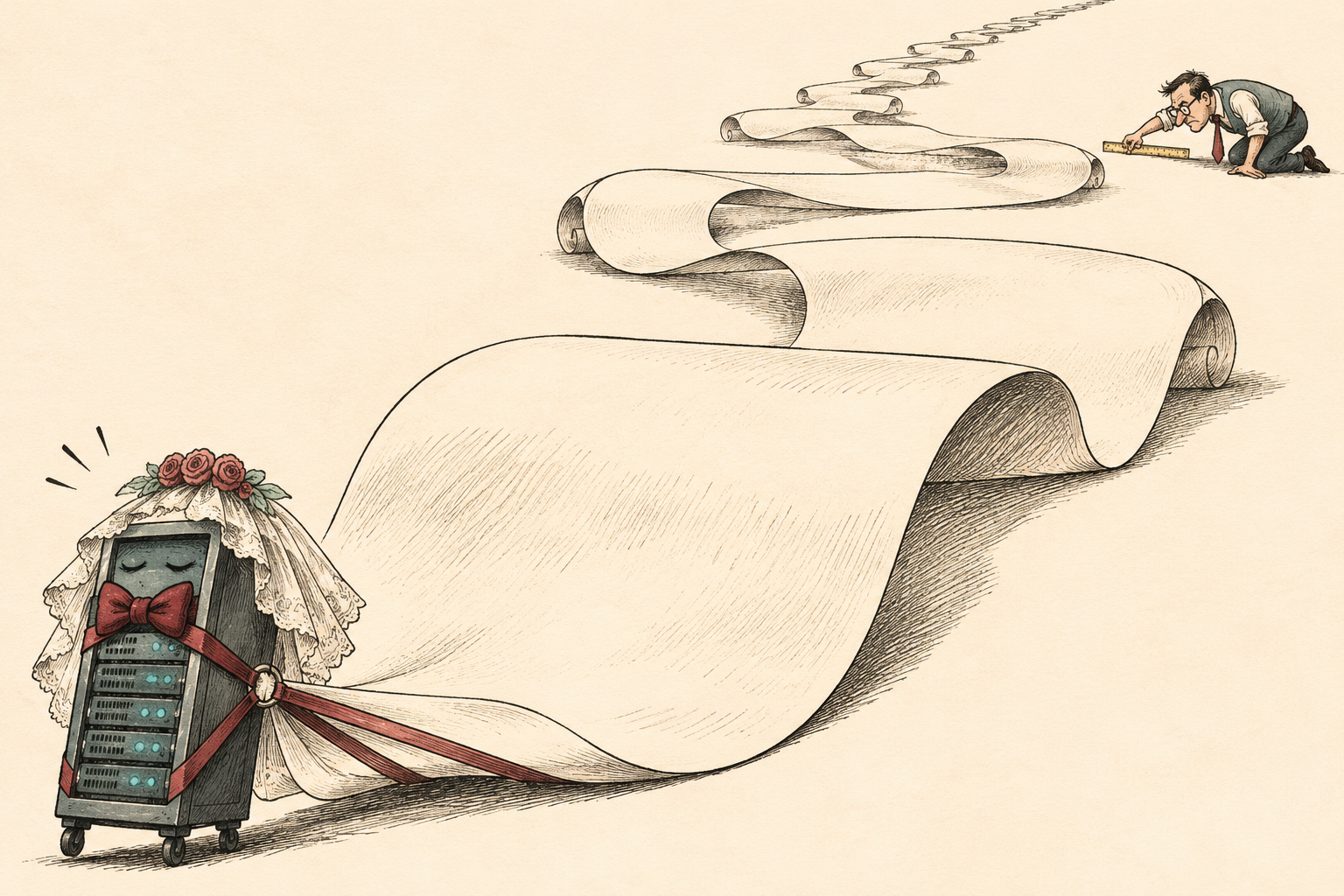
Conceptual ink illustration of a server bride trailing an enormous blank contract.
Catch up quick
  1. Anthropic discloses $895.4 billion in commitments spread across years of compute and infrastructure.
  2. OpenAI puts everyday errands on the exam paper, and future campuses on a more flexible power plan.
  3. Rubin spots a dwarf-planet candidate; confirmation still needs more observations.
  4. Two medical studies point toward more useful AI measurements, with clinical limits intact.

Open what interests you

01THE LONG COMMITMENTThe computer comes with quite a trainAnthropic's amended filing puts a $895.4 billion price on years of promised capacity.A server dressed for a wedding drags an immense paper train, a metaphor for long-term commitments.
The striking number in Anthropic's November 2 amended IPO filing is a commitment total. Purchase agreements and leases add up to about $895.4 billion, almost all for compute and infrastructure, including leases that have not begun.

About $447.5 billion is expected before the end of 2030, with most of the rest stretching from 2031 through 2045. Roughly $69.8 billion falls due in the twelve months after September 30, 2026. These are future contractual obligations, not a quarterly expense or money already spent.

There is an important escape-clause qualification: about $213.8 billion concerns arrangements with exercisable termination rights or conditions before commencement. Anthropic also warns that some agreements require payment regardless of how much capacity it uses. The business challenge is matching a very long shopping list to demand that can change much faster. Read the amended filing.
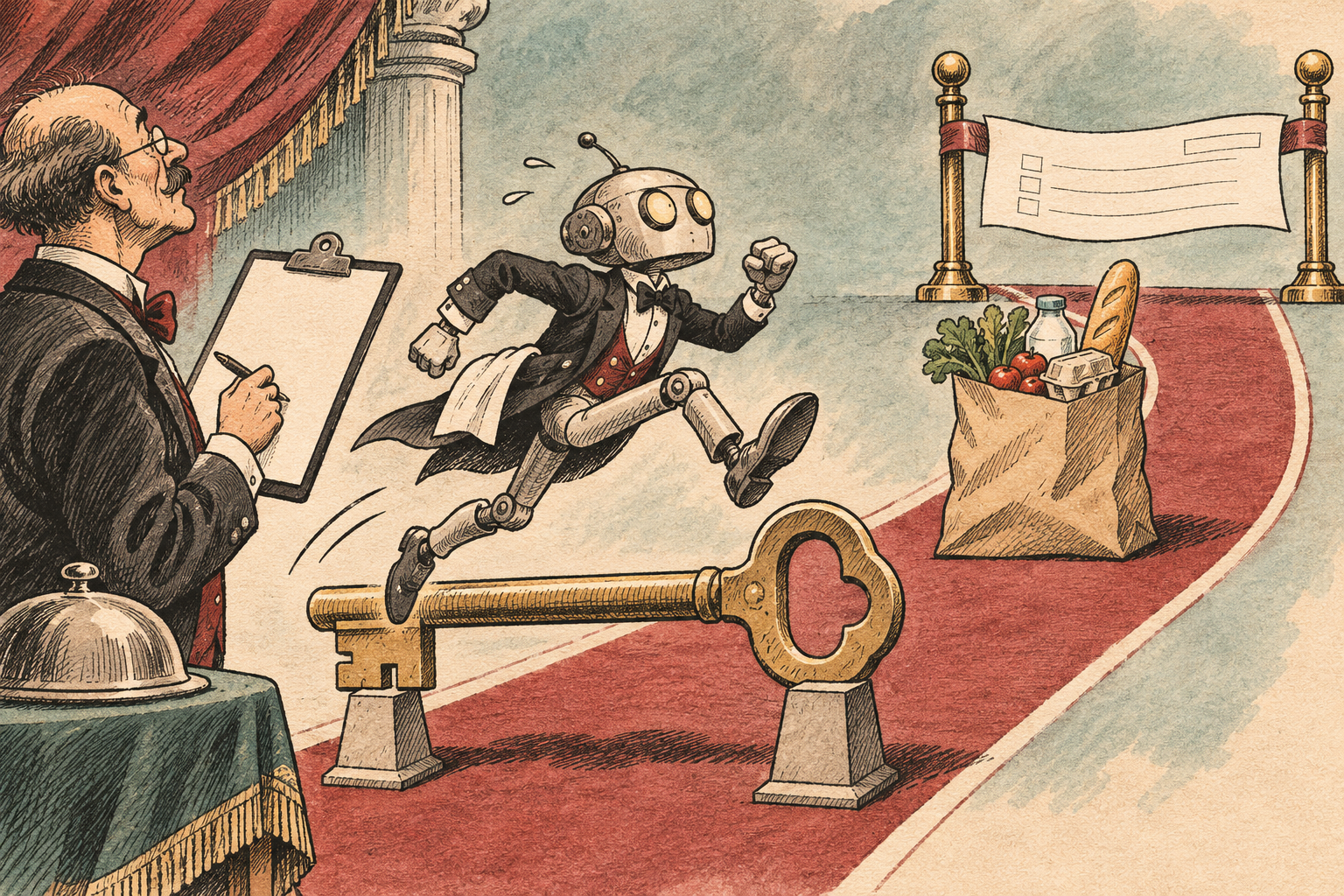

02EVERYDAY AIA harder question: did the errand get done?LifeVal tests useful personal-assistant work, with the messy bits left in view.A mechanical butler runs an obstacle course of a key, groceries and blank paperwork.

OpenAI's November 2 LifeVal release shifts the exam toward household administration, shopping, caregiving and government services. The accompanying paper evaluates five model generations on 169 tasks. Task selection draws on time-use research and a survey of 3,995 respondents.

That makes an appealing test: can an assistant actually navigate practical work? It is still a benchmark designed and reported by the model developer, rather than independent proof that a product will reliably handle your particular errands.

The paper acknowledges limits. Its willingness-to-pay survey was US-centered and in English; self-reported preferences stand in for lasting real-world value. Some browsing information can change between runs. Incorrect information and missed personal context remain failure modes. A convincing demo is the start of the conversation; dependable follow-through is the useful part. Company announcement · Methods and limitations.

03POWER & MANNERSThe biggest guest learns to turn downOpenAI's grid plan makes flexibility part of the campus promise.A giant server turns a dimmer beside a small lit house, a conceptual image of flexible demand.

OpenAI says its new Grid Protectors Program will arrange for future computing campuses to reduce electricity demand when local grids are under strain. Depending on the site, storage or on-site generation could also help.

The concrete example is a planned campus in Effingham County, Georgia. OpenAI says its agreement with Georgia Power includes up to 1,000 megawatts of flexible demand response, alongside a commitment to pay the project's infrastructure and electricity-service costs.

That is a potential reduction in demand once the campus operates, not a gigawatt of new power already being supplied. The site remains in development, and arrangements elsewhere still need to be finalized. The promise is worth tracking: a very large electricity customer that can yield at peak times could be easier for the grid to accommodate. OpenAI's November 2 announcement.

04THE OUTER REACHESOne more world at the velvet ropeRubin's first dwarf-planet candidate still has a confirmation step to clear.An icy candidate waits at a velvet rope while an astronomer examines it.

Rubin Observatory announced 2026 ED138 on October 27: a distant object identified in its survey observations by Matthew Holman. It is currently about 46 times Earth's distance from the Sun.

Its brightness and estimated reflectivity suggest a diameter somewhere between 600 and 1,500 kilometers. That range is wide for a reason. Infrared observations are still needed to constrain its size and establish its nature as a dwarf planet.

The discovery also shows why repeated observations matter. Rubin's ability to find moving points of light among crowded background stars helped reveal an object that had escaped earlier detection. For now, the satisfying news is a promising new candidate, with follow-up science still to do. Rubin Observatory's discovery report.

Three more worth opening
Apple's September quarter sets a revenue record

Apple reported $114.5 billion in fiscal fourth-quarter revenue, up 12% year over year, and diluted EPS of $2.10. Tariff refunds added roughly one percentage point to gross margin and $0.05 to EPS. The quarter ended September 26; the results were announced November 2. Apple's results.

A $115 billion connectivity agreement, still to close

Marvell agreed to acquire Lumentum in an all-stock transaction with an implied enterprise value of $115 billion. The companies expect closing in the first half of 2028, subject to shareholder and regulatory approvals and other conditions. Company announcement.

Abu Dhabi starts with the paperwork

Four OpenAI agreements span government, energy, investment and broader AI adoption. The official account says a food-import pilot already helps officials assess rules in machine-readable form, while officials retain final accountability. The agreements' broader benefits remain ambitions to be demonstrated. Abu Dhabi Media Office, November 2.

Today's good news

A more personal map for childhood brain-tumor care

Dana-Farber researchers reported MANTIS on November 3, an AI model that uses tumor methylation profiles to estimate survival for children with medulloblastoma and ependymoma. It performed better than existing risk approaches across several validation cohorts. An analysis of radiation doses also suggested that some children with average-risk medulloblastoma might benefit from less intensive treatment. Those findings point toward further clinical study, not a recommendation to change a child's care today. The hopeful idea is to extract more useful guidance from molecular tests already used in diagnosis.

Read the source ↗
More good news

A clearer heart measurement, with a clinician still in the loop

A UCL-led study, reported November 3, compared AI and clinician measurements from heart MRI scans of 27,382 patients. The AI measurements were slightly but significantly better at predicting mortality risk during follow-up. That is evidence about prediction, not proof that using the tool makes patients live longer. Researchers also reported errors in about 1% of patients and stressed human review. Better, faster measurement could support care; clinical judgment still matters.

Read the source ↗
Close ×Enlarged comic