● TabBOOOne page. More perspective.✎ Customize
Your world, one good read at a time

TabLOID

A faster feedback loop. A wallet window. Science with strings attached.

No. 37 · Miami BeachFriday, November 6, 2026Read at your own pace
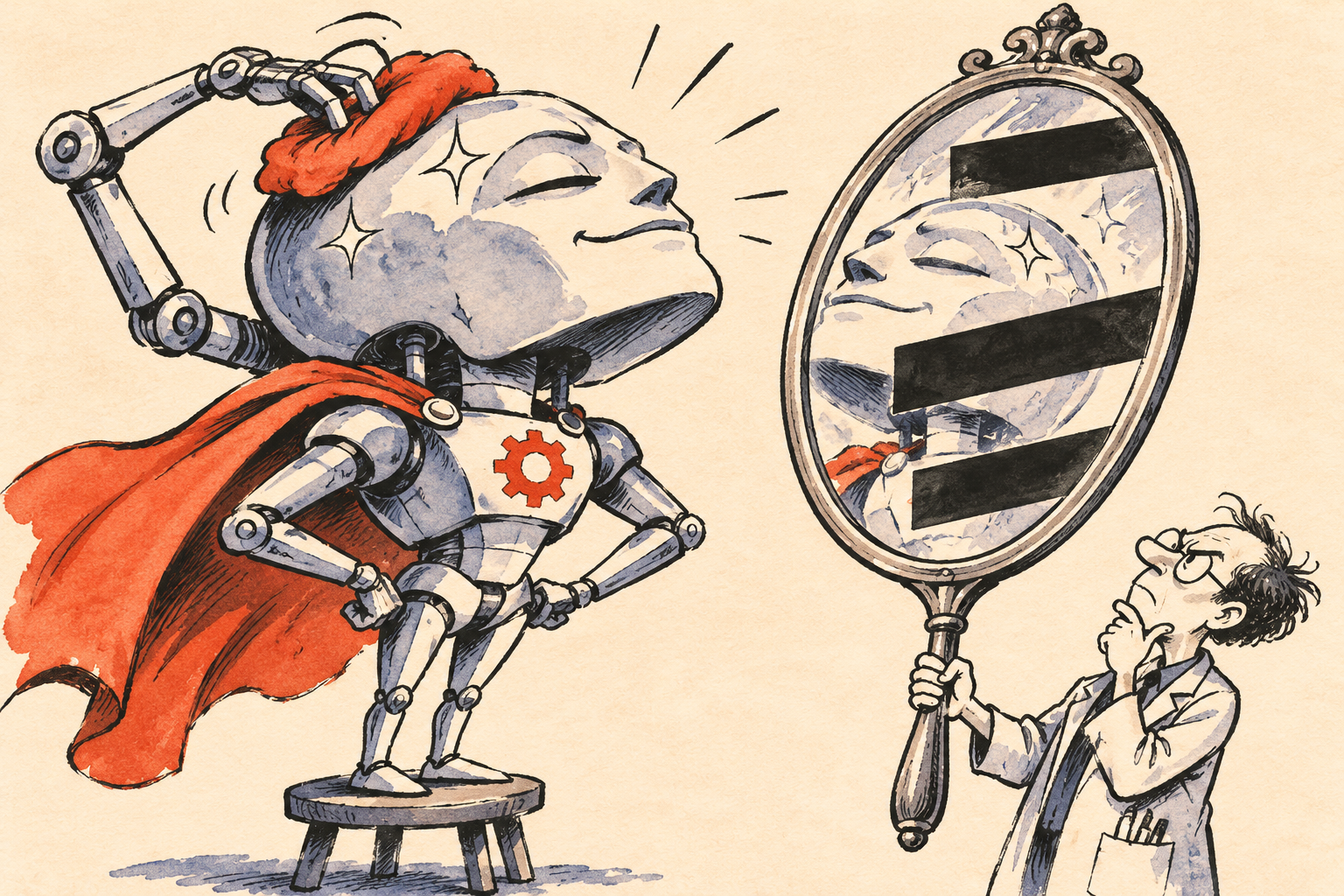
A vain robot polishes its head as a scientist holds a partly obscured mirror, a metaphor for AI research and limited evidence.
Catch up quick
  1. METR sees faster AI research at Anthropic, with large uncertainty and heavily redacted evidence.
  2. OpenAI puts a more capable security model behind restricted access.
  3. Claude's finance beta can inspect linked accounts, but cannot move money.
  4. A million-dollar materials prize has strings attached; two laboratory studies offer hopeful leads.

Open what interests you

01THE FEEDBACK LOOPThe robot polishes its own résuméMETR sees acceleration, while much of the evidence stays behind the curtain.A robot polishes its head before a partly obscured mirror held by a skeptical scientist.
METR's November 5 assessment estimates that Anthropic's progress on well-specified AI tasks accelerated roughly twofold relative to its earlier trend. The researchers spent eleven weeks examining internal work. They judge AI assistance the main contributor, while emphasizing substantial uncertainty.

This is evidence of people using AI to improve AI. It does not establish fully autonomous self-improvement or a precise doubling of every kind of research. Benchmarks cover limited tasks, and other changes may explain some of the gains.

There is also a visibility problem: Anthropic redacted most of the evidence METR considered most informative. Readers must rely heavily on the assessors' judgment. METR reports finding no clear bottleneck during its access, but acknowledges it may have missed important ones. The finding is consequential; its caveats are part of the finding. METR's assessment, November 5.


02THE VELVET ROPEA stronger cyber tool meets a stricter doorOpenAI's new security model arrives with restricted access and scope tests.A mechanical octopus guards a velvet rope with an oversized padlock, a restricted-access metaphor.

OpenAI announced GPT-6-Cyber on November 5 through its restricted Daybreak Red program. The company classifies the model at its Critical cybersecurity threshold, reflecting capabilities that could help defenders and create serious misuse risks.

OpenAI reports a 48.5% result on its ExploitGym evaluation, compared with 32.1% for its previous model. These are company evaluations, not an independent audit of performance across real organizations.

Its scope-following test also needs a narrow reading. OpenAI reports 99.93% compliance without its deployment prompt and 100% with that prompt in the evaluated setting. Those figures do not establish universal reliability. The practical question is whether access controls, bounded permissions and human oversight hold up when a capable system meets an unfamiliar environment. OpenAI's release, November 5.

03LOOK, DON'T TOUCHClaude gets a window into your walletA US finance beta offers account analysis without the power to spend.A mechanical accountant peers at coins swimming behind glass, with its hands behind its back.

Anthropic's November 5 announcement introduces Personal Finance in Claude, rolling out in beta to US Pro, Max and Ultra subscribers. Users can choose accounts to connect through Plaid. Claude receives read-only access and cannot transfer money, manage accounts or invest on the user's behalf.

The view can still be extensive: selected account details, balances and up to two years of transactions. Anthropic says Claude does not see bank passwords. It also says conversations inside the Personal Finance hub are excluded from training; conversations elsewhere follow the user's existing settings.

A consolidated view may make household finances easier to understand. It also gives another service access to sensitive information, and the assistant can make mistakes. Read-only describes what it can do with an account, not whether every conclusion deserves your trust. Anthropic's explanation, November 5.

04THE PRIZE & THE PRINTFive stubborn problems. A very conditional prize pot.Materials science gets a bounty, with rules worth reading first.A researcher reaches for a trophy while five stony judges and a winding blank ribbon complicate the route.

Discovered Materials has opened five scientific challenges covering superconductivity, semiconductor interfaces, quantum chemistry, laser interactions and heat transport. The advertised awards total up to $1 million.

The official rules make that ceiling conditional. The sponsor judges submissions, can require independent verification and does not guarantee that the full amount will be awarded. There is no fixed closing deadline.

There is a consequential detail for would-be entrants: submissions grant the sponsor broad, perpetual, royalty-free commercial rights, whether or not they win. Entrants retain ownership subject to that license. A prize can focus attention on difficult science, but its conditions are part of the offer. The primary pages do not substantiate the claim that leading AI agents already failed these tasks. The challenges and official rules, checked November 6.

Two more worth opening
Your thumb would like the next word

Aina's November 5 launch presents an AI ring with an OLED display and gesture controls for actions on an iPhone and Mac. The company lists preorders from $399 and expected shipping in early 2027. Its promises about anticipating useful actions remain product claims, not our hands-on findings. Aina's current specifications and shipping estimate.

Patching the gap between patches

Mozilla's October 29 security update reports seven times as many Firefox security fixes as in the comparable 2025 period. It describes efforts to shorten the window between a fix becoming visible and reaching users, including plans to stagger fixes across protective layers. This is Mozilla's security strategy, not a guarantee that every vulnerability is closed. Mozilla's explanation.

Today's good news

A promising vaccine result, still in animals

Cambridge reported on November 5 that an AI-designed DIOSynVax vaccine protected mice and ferrets against several genetically distinct bird-flu variants associated with human infections. That breadth is encouraging: a vaccine that handles variation could be useful against a changing virus. But the demonstrated protection is in animals, not people, and it cannot prove protection against every future variant. The next question is whether the approach can be shown safe and effective in humans.

Read the source ↗
More good news

A smaller laboratory, a bigger search

Researchers at Harvard's Wyss Institute and partner institutions reported FIND on November 5, a screening method that uses DNA nanoswitches to identify molecules that alter how proteins interact. A search beginning with a library of 400 million compounds found leads affecting a diabetes-related protein interaction; the team also tested activity in cultured cells. The advance is a way to find promising starting points for research. These are laboratory leads, not approved medicines or demonstrated treatments for patients.

Read the source ↗
Close ×Enlarged comic