● TabBOOOne page. More perspective.✎ Customize
Your world, one good read at a time

TabLOID

Ongoing agents. Quiet glasses. Big engines. Promises with fine print.

No. 38 · Miami BeachSaturday, November 7, 2026Read at your own pace
Mechanical office acrobats carry a long blank scroll while their human ringmaster is offered a pen for approval.
Catch up quick
  1. Perplexity gives ongoing work to Teammates, with results still needing review.
  2. webAI's smaller model posts a larger score on a company-run, curated evaluation.
  3. Silent-speech glasses remain a prototype; a rocket-engine agreement remains a build plan.
  4. A tentative HIV prevention approval opens a route toward wider access, with delivery hurdles still ahead.

Open what interests you

01THE OFFICE CIRCUSYour new colleagues don't leave the chatPerplexity puts ongoing assignments inside its agent workspace.Robotic office acrobats and a worried human ringmaster stage a metaphor for supervising ongoing agent work.

Perplexity's November 6 changelog introduces Teammates for complex, continuing work. The company says they can plan tasks, run work in parallel, retain context and bring results back for review. They draw on its Computer tasks, Skills, memory and tools, and can collaborate with other Teammates.

The launch is available to Max subscribers on the web. Perplexity also describes connections to workplace tools, including Slack. These are the company's product descriptions, not an independent finding that the agents reliably finish every assignment.

The appealing shift is from asking a fresh question to maintaining a standing brief. The practical test is whether the resulting work is useful enough to justify the supervision. A recurring assignment still needs a clear scope, appropriate access and someone willing to inspect what comes back. Perplexity's changelog, November 6.
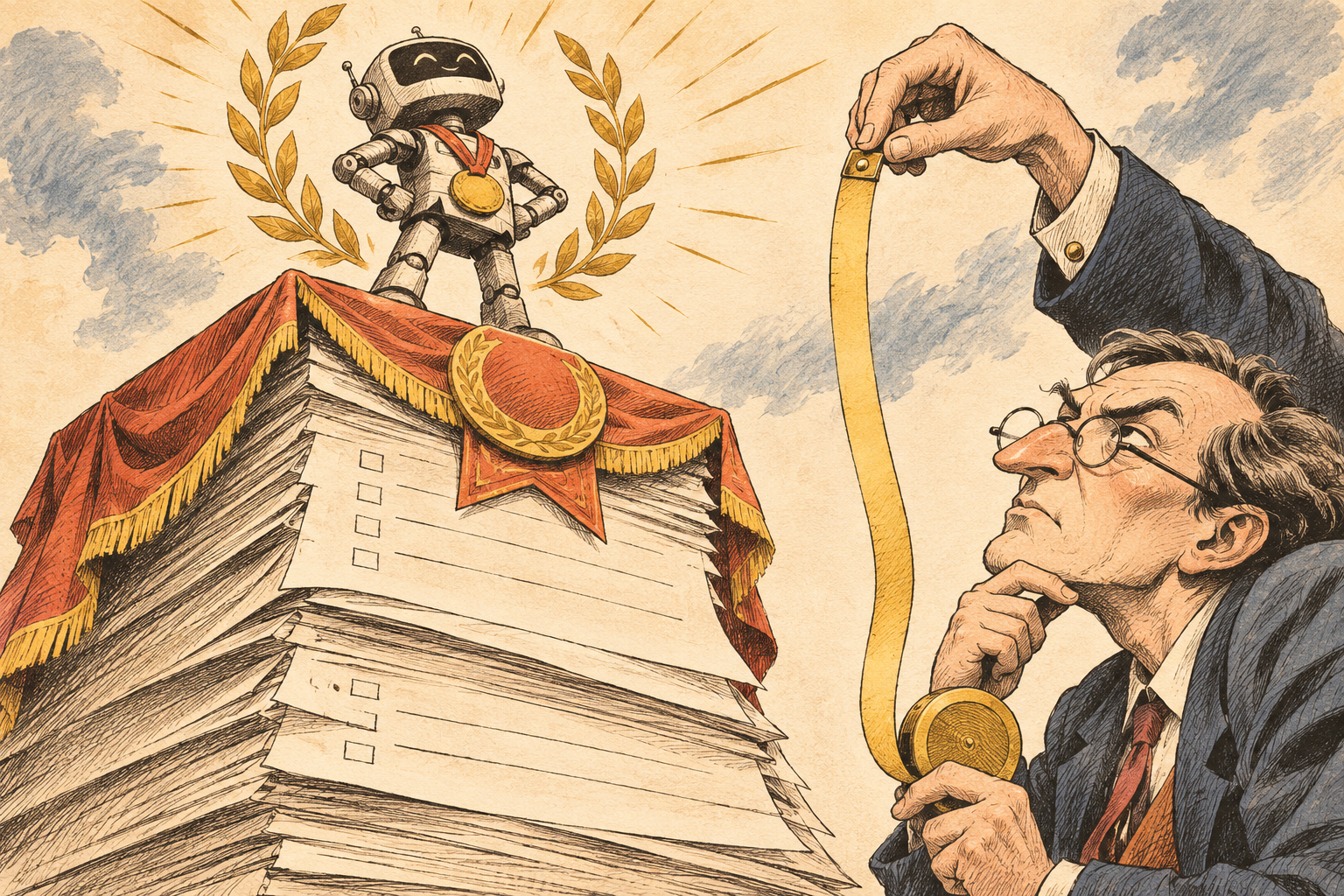

02THE PODIUM & THE RULERA small model finds a very tall podiumwebAI's score comes with a methodology worth opening.A small robot stands on a podium of exam papers while a skeptical judge measures it, a metaphor for evaluating benchmark claims.

webAI reports that its Meridian Air CivoE system lifts a 12-billion-parameter foundation model's composite evaluation score from 59.8 to 85.5. Its approach combines specialized experts rather than simply making the underlying model larger.

Those numbers are normalized scores across 14 curated benchmark datasets. They are not percentages of all questions answered correctly. The company selected task families where the foundation was already competitive, then evaluated its specialist system alongside other models.

The comparison has limits: it is company-run, and exact competitor revisions and reasoning settings were not fully controlled. The results support examining this particular method on these tasks. They do not establish that a small model has become a universal winner. For buyers interested in private deployment, the useful follow-up is a comparison on their own workload. webAI's methods and results, checked November 7.

03SAY IT WITHOUT SOUNDThe glasses would like a quiet wordA silent-speech prototype senses movements, not private thoughts.A quill attached to spectacles makes abstract ink strokes; an unfinished circuit board signals a conceptual prototype.

The Subvocal Company's founders describe glasses that use radio-frequency sensing to detect small facial muscle movements as a wearer silently articulates words. Software turns those signals into text. The intended interaction is silent speech, not reading an unspoken thought.

In their Y Combinator launch, the founders claim speeds above 200 words per minute. That is their reported performance, not an independently established speed for ordinary users in varied conditions.

The hardware is also still in development. The founders describe a semi-portable board connected to glasses, while the polished product imagery represents the intended finished device. Miniaturization and broader training remain work ahead. If the approach becomes dependable, it could offer another way to enter text without speaking aloud. For now, the prototype and its promises belong in separate columns. The founders' launch description, checked November 7.

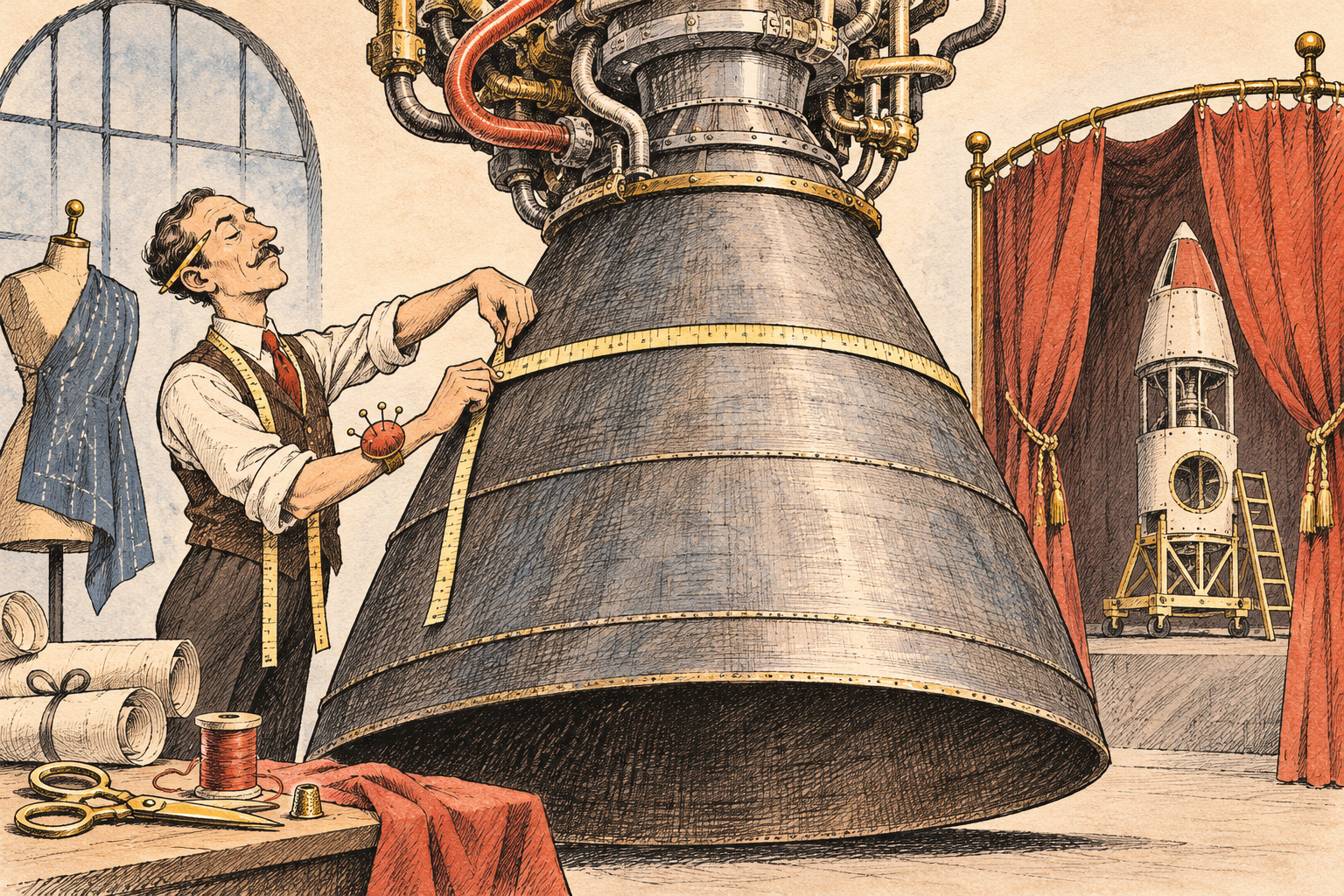
04BESPOKE THRUSTA rocket company orders its enginesFirefly's agreement gives AST SpaceMobile a substantial starting point.A tailor measures a giant engine bell while an unfinished rocket waits, a conceptual illustration of engine procurement.

Firefly announced a deal worth more than $1.3 billion with AST SpaceMobile on November 6. It covers 36 rocket engines, a manufacturing license and three years of engineering support for AST's planned heavy-lift rocket.

The package includes 27 Miranda engines and nine vacuum-variant Vira engines for the first three vehicles. Firefly retains ownership of its engine intellectual property. Payment combines cash and AST shares.

Buying a developed engine design can remove a formidable piece of work from a new launch program. It does not turn the rest of a rocket into a finished product. Vehicle integration, production and flight testing remain consequential steps. The agreement is a major commitment to building launch capacity; it is not evidence that AST's new rocket has flown. Firefly's announcement, November 6.

Two more worth opening
Send the same layers around again

Looped-transformer research reuses model layers to add computation without adding a fresh set of weights each time. A 2025 paper found gains on selected reasoning tasks, including synthetic problems. That is a research direction, not evidence about the undisclosed architecture of a forthcoming flagship model. The research paper, February 2025.

One last roll in orbit

NASA reports that astronauts installed and deployed the station's eighth and final roll-out solar array on November 5, completing the power-augmentation project. It is a finished installation, not a launch forecast. NASA's spacewalk report.

Today's good news

A lower-cost prevention shot clears a conditional hurdle

Dr. Reddy's announced FDA tentative approval for its generic lenacapavir HIV prevention medicine on November 2 through the PEPFAR pathway. Partners plan a price of $40 per person per year in 120 licensed countries outside the US, with initial supplies expected by the end of 2026 and broader availability in 2027. This is not full approval for US generic sales, a US price cut, or a vaccine. National approvals and delivery arrangements still matter, and HIV testing is required before starting and before subsequent injections. The milestone creates a route toward wider access; it does not mean everyone who needs prevention can obtain it today.

Read the source ↗
More good news

A forest pledge, with delivery still ahead

The Tropical Forest Forever Facility reported on October 30 that the Netherlands plans to invest up to $500 million over ten years. The formal pledge is expected at COP31. It adds prospective backing for payments tied to keeping forests standing, not cash already delivered to forest communities. The facility's first country payments are planned for 2027–2029.

Read the source ↗
Close ×Enlarged comic