● TabBOOOne page. More perspective.✎ Customize
Your world, one good read at a time

TabLOID

A board review. The keys on display. One mathematical knot.

No. 40 · Miami BeachMonday, November 9, 2026Read at your own pace
An oversized magnifying glass examines an empty chip-shaped boardroom chair, a metaphor for an independent corporate review.
Catch up quick
  1. Nvidia's board opens an independent review and says it has no reason to believe company secrets were compromised.
  2. Anthropic refreshes its high-end models; Apiiro finds credentials in public agent settings.
  3. A claimed AI-assisted mathematical proof gets a careful reading.
  4. New York's air-quality monitoring offers a qualified piece of good news.

Open what interests you

01UNDER THE MAGNIFYING GLASSNvidia's board opens the fileAn independent investigation begins. Its conclusion has not arrived.An inspector studies an empty chip-shaped chair. Conceptual art about a review, not evidence of misconduct.

Nvidia's board announced on November 8 that independent directors, assisted by outside counsel, will investigate reports concerning a foreign intelligence effort targeting CEO Jensen Huang. The board said it had no reason to believe national security or Nvidia secrets had been compromised, while committing to examine the available information. It also expressed confidence in Huang and his leadership team.

In a separate company message, Huang acknowledged marital infidelity, apologized and said he would cooperate with the investigation. That admission does not establish the separate national-security allegations.

The concrete development is a formal review. Neither the announcement nor the apology amounts to a finding that information was stolen. The board now has an investigative process to conduct and conclusions to substantiate. The magnifying glass is out; the verdict is not. Board statement, November 8 · Huang's company message, November 8.


02THE MODEL GETS A FITTINGClaude's top tier gets another alterationFable 5.2 and Mythos 5.2 share a model, with different safeguards and access.Two robot tailors adjust one oversized jacket, a metaphor for versions of the same underlying AI model.

Anthropic introduced Claude Fable 5.2 and Mythos 5.2 on November 9. The company describes improvements in coding, reasoning and vision, and says output generation is up to 30% faster than the preceding 5.1 versions.

The two products use the same underlying model. Fable carries cybersecurity and biology safeguards for broader availability; organizations seeking Mythos for beneficial work in those fields must apply through verification programs. Standard API pricing is $8 per million input tokens and $40 per million output tokens. An optional faster mode costs twice those rates.

Those capability and speed claims come from Anthropic's own testing. They are a reason to evaluate the models on actual work, not a promise that every task will finish correctly or cost less. The tailoring looks ambitious. Inspect the seams before wearing it to the important meeting. Anthropic's announcement, November 9.

03THE KEY IS ON YOUR LAPELA saved approval can save the password, tooApiiro's research traces exposed credentials to files that were supposed to stay local.A mechanical assistant wears its key on the outside of a jacket, a metaphor for exposing stored credentials.

Security company Apiiro reports finding 1,379 distinct credentials in 1,122 public copies of Claude Code's local settings file. Its broader investigation, including other settings, history and transcripts, counted 2,539 across 1,994 repositories.

The mechanism is painfully ordinary: approving a command permanently can preserve the exact command in an allow rule. If it contains a password or token, the saved rule may contain that too. Publication happens when those files reach a public repository or another shared package.

Apiiro did not use or test the credentials, so its counts describe exposure, not a confirmed number of working keys or intrusions. Its November 8 update also includes Anthropic's response: the team was examining possible changes. Claude Code attempts to exclude the local file from Git, but that protection has limits.

For developers, the useful lesson is to keep secrets out of command strings, review agent settings before sharing, and rotate exposed credentials. Deleting today's file does not erase yesterday's copies. Apiiro research, November 5, updated November 8.

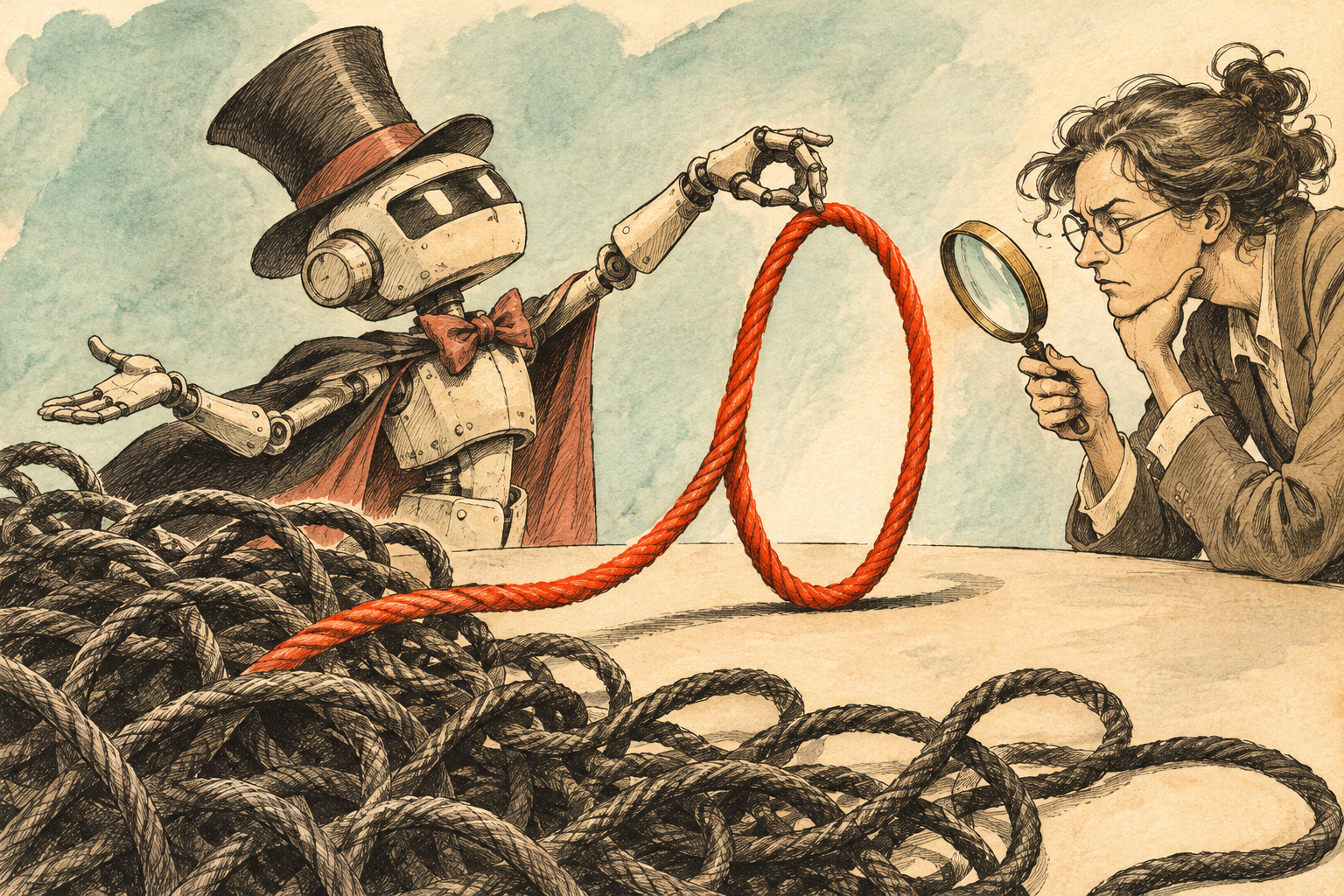
04ONE KNOT, CAREFULLY UNTIEDAn AI-assisted proof makes a substantial claimPSI reports a solution to the Aaronson–Ambainis conjecture, with a specific mathematical scope.A robot magician presents an untied loop to a skeptical mathematician, a metaphor for scrutiny of an AI-assisted proof.

Physical Superintelligence says its research system, using a non-public Anthropic model, found a proof of the Aaronson–Ambainis conjecture. Its November 6 account links a paper and code, and says the Lean proof assistant accepted the formalized result.

The question concerns how many times a computer must query its input. In the setting described by PSI, the result limits exponential quantum advantages on typical inputs for yes-or-no problems. It is not a declaration that ordinary computers can efficiently replace every quantum computation, nor does it remove the special structure exploited by Shor's algorithm.

PSI also reports that four Stanford researchers have been reading the proof and preparing a shorter explanation. TabLOID has checked the public research account, not independently reproduced the formal verification. The claim is significant enough to inspect carefully. A proof assistant's acceptance and wider mathematical scrutiny do different jobs, and readers should keep both in view. PSI research account, November 6.

The memory department
Less filing, more remembering

Anthropic compared one Pokémon Red run each for Sonnet 3.7 and Fable 5 at roughly 10,000 steps. Sonnet wrote 413 memory files and earned one badge; Fable used ten files and earned four. The company's November 6 research argues for retaining useful strategies rather than copying transient screen state. This is a limited illustrative comparison, not proof that fewer notes always improve performance. Anthropic's agent-memory research.

Today's good news

A feared pollution shift did not materialize

New York City's August 14 evaluation found air quality stable or slightly improved during the first year of congestion pricing. Crucially, it found no increased pollution attributable to the program in the environmental-justice communities along major highways that it examined. That is reassuring evidence about a specific concern: traffic avoiding the toll did not produce the feared air-quality deterioration in those monitored neighborhoods. It is not evidence that congestion pricing alone caused a large citywide pollution reduction. The study used observations from a year before tolling and a year after, with statistical controls for other influences. Continued monitoring remains part of the work. These are findings published in August, revisited today, rather than a new November measurement.

Read the source ↗
Close ×Enlarged comic